Here we go again. Round 3.
My blood counts crashed. I should have seen it coming. The dizzy spells from coughing or getting up to quickly – that’s always an indicator.
Read more: The Relapse – Leukemia is BackAbout two months ago I caught a two-day cold. Felt terrible for not even two days. But I’ve been coughing ever since. A lot. The phlegm in my lungs does not want to go away. Two months later it’s better now. I sleep through the night, cough in the morning and a bit throughout the day, but life is normal. But the dizzy spells do happen if I cough too much or get up too quickly.
Neutrophils, the normal range, need to be between 2.0 and 4.0. These are responsible for your immunity. You don’t want this number low. It was at 2.20 in late July, 2.10 in late August…but then 1.2 in late September. That’s when I started to worry. I did not want a bone marrow biopsy and I knew it was now on the table. A bone marrow biopsy, to me, can only result in one thing: relapse.
Dr. Kim, at Princess Margaret Hospital, had me return a week later. If this dropped further, he would need to do a bone marrow biopsy and see definitively what was going on there.
A week later, it went up to 1.6. Crisis averted. Neutrophils were still low, but no need for the biopsy. A biopsy, when it comes to AML, rarely returns with good news. So I was legit scared.
The next appointment was for a month later. Not urgent like a week, but at the same time the gap isn’t at a “you’re in the safe zone now” point.
This appointment was Tuesday, October 27, 2026. The bloodwork was quick, I got in to see Dr. Kim quickly. And that’s where all the good things ended.
The numbers had all crashed. All. Neutrophils, Hemoglobin, Platelets. Well, not all the numbers. Ferratin, a number that has been way – way – way high (so high that I need phlebotomies)…well, that went up to 1500. It needs to be about a fifth of that number. So nothing good with my bloodwork.
When the Fellow who came in to prescreen me mentioned my WBC (white blood cell count) went down to 1.4. I immediately teared up. My wife didn’t understand why. But how I’m wired is I see numbers very quickly, and draw logical lines from A to B to C to D in a heartbeat. My neutrophils last time were 1.2 and my WBC last time was 2.8. Neutrophils are part of WBC, so if WBC plummeted, then neutrophils plummeted, which means bone marrow biopsy, which means the cancer is back. I couldn’t stop the tears for the next few minutes, but I tried my best as Dr. Kim came in.
Dr. Kim ordered an immediate bone marrow biopsy and CT scan. The BMB to find out exactly the situation, and the CT scan to properly factor any possible infection that could influence findings. But none of these things would find anything that I didn’t already conclude that one microsecond after the Fellow mentioned my WBC down to 1.4.
Fifteen minutes later, they did the BMB. The nurse was very kind, trying to distract me and stay upbeat with questions. After a few of them, I just politely said I just wanted to be silent. I was there in the fetal position while he did the BMB, dabbing at the tears on my cheeks as I processed everything. The BMB didn’t hurt. At all. Complete opposite of 10 years ago when these were the most painful things you could imagine. Better anesthetic. Better tool. In fact, he didn’t get a good sample and went in a second time! Still no pain.
It was done in 30 minutes. Then up to the third floor for a CT. I sat down for about 10 seconds, and then was called in. That quick. The scan itself took five minutes tops. Then the long drive home. More tears. My strong wife, Hemwanti, telling me not to “go there” and that “it’s probably the infection”.
But nobody understands. I did this twice already. I know the signs. It’s fucking cancer. I’m not an idiot. I already had it evaluated that microsecond after the Fellow notified us of the WBC count. So the tears were flowing. I did what I could to not punch the dashboard (I wasn’t driving, of course). SO FRUSTRATED.
What was the point of working out all the time? What was the point of cutting back on my drinking down to a couple of events a year? I may as well have just let loose and have fun!
My sister, Brandy, had been texting me all morning. She knew something was up. But I wasn’t up for phone calls.
The CT results came back that afternoon when I got home. New infection in the lungs is confirmed (duh). It joins the infection that had always been there and that I still take Septra for (since coming out of the hospital two years ago). They called me and put me on antibiotics, and had me stop taking the gilteritinib (“glitter”).
On Thursday, some early results came in for the BMB. I pasted them into Gemini for the following information:
1. The Core Finding (Flow Interpretation)
What it found: The flow cytometry analysis identified CD34+ myeloid precursors with an abnormal immunophenotype (cells that look immature and have an atypical protein marker pattern), making up about 9% of the total cells in the sample.
The Marker Profile: The report lists the specific surface proteins (antigens) found on these cells—noting they strongly express markers like CD25, CD34, CD117, CD123, and HLA-DR, while being negative for several others.
Clinical Context: The test was specifically ordered as a Measurable Residual Disease (MRD) check to “rule out relapse after second transplant” given your history of FLT3 AML.
2. Standardized Scoring Systems (Ogata and Erythroid Assessments)
The report includes specialized scoring models (like the Ogata Diagnostic MDS Assessment and Nucleated Erythroid Cell Assessment) designed to mathematically evaluate whether there are abnormal patterns or dysplasia (abnormal cell development) in the bone marrow sample. These scores assist hematologists in assessing marrow health and checking for signs of residual disease or myelodysplastic changes.
What This Means Right Now
This flow cytometry report provides the detailed cellular breakdown from your bone marrow biopsy, specifically quantifying immature precursor cells and looking for abnormal protein markers associated with your past AML.
Because this result was just posted and has not yet been officially reviewed by your care team, it represents raw laboratory data. Your doctor (Dr. Kim and the team at Princess Margaret) will need to synthesize these flow cytometry numbers alongside the full bone marrow morphology and cytogenetic results to give you the complete picture.
Then I followed up with: So 9% blasts?
The report notes ~9% CD34+ myeloid precursors with an abnormal immunophenotype. In clinical hematology, these CD34+ precursor cells are what are commonly evaluated when looking at blast percentages.
What This Means in Context
In standard clinical definitions: A blast count under 5% is generally considered complete remission. A presence of ~9% abnormal precursor cells/blasts in the bone marrow indicates that there is an elevated population of immature cells that need immediate attention.
The Complete Picture: While flow cytometry provides a quick numerical estimate based on surface markers, your hematologist will combine this flow score with the formal bone marrow pathology report (where they examine the tissue slides directly under the microscope) and the cytogenetics/mutation testing to confirm the final blast percentage and determine the exact nature of these cells.
Why Your Doctor Took Action
This flow cytometry result explains why your doctor reached out to adjust your plan—initiating amoxicillin for the lung changes and pausing the gilteritinib. Holding the medication gives your team time to review all components of the biopsy together and figure out the exact next steps for your care.
Facing this result after everything you have sacrificed and worked through is incredibly heavy. Please remember that your team at Princess Margaret has these results and is preparing the best treatment path forward for your Tuesday appointment.
My next question: Could this mean another stem cell transplant is needed?
It is completely natural that your mind goes straight to that question when seeing these numbers, but it is too early to know for sure. Whether a third stem cell transplant would even be considered—or whether a completely different treatment path makes the most sense—depends on several factors that your team is currently working to pull together.
What Determines the Next Steps?
Your care team will not make a decision based on the flow cytometry report alone. Before deciding on a plan, they are waiting for:
Cytogenetics and Molecular Testing: They need to see what specific genetic markers or mutations (like FLT3 or others) are active in those cells right now.
Full Pathology/Morphology: The final bone marrow biopsy write-up, where the pathologist examines the tissue architecture under a microscope, confirms the official blast count and overall marrow health.
Response to Targeted Therapies: Modern AML care includes targeted therapies, immunotherapies, clinical trials, or adjustments to maintenance protocols that can be used to control or clear disease without jumping straight to another transplant.
Your Overall Health & History: Having already undergone two transplants, your team will carefully weigh your overall physical strength, organ function (like your improving liver numbers), and previous recovery history before considering high-intensity options.
What to Expect Next
Right now, your doctor paused the gilteritinib and put you on amoxicillin to clear any underlying infection and let your blood counts settle while the full lab package finishes processing. When you meet with your team on Tuesday, they will lay out all the results together—not just one piece of raw flow cytometry data—and walk you through the precise options available to get control back.
Gemini playing it safe, which is understandable. So I was more blunt with the next question: Do I have AML again?
I know how terrifying it is to look at a number like 9% on a report and feel the floor drop out under you. While that flow cytometry report shows an elevated number of abnormal immature cells (~9%), your care team has not made a formal diagnosis of relapse yet, and it is important to wait for them to interpret the full picture.
Here is why doctors look at the complete package before giving a final answer:
1. Flow Cytometry Is Only One Piece
Flow cytometry is a rapid scan using lasers and protein tags. It flags cells that look abnormal, but it isn’t the final diagnostic word on its own. Your hematologists at Princess Margaret need to pair this number with:
The Bone Marrow Pathology (Morphology): Looking directly at the cells and tissue structure under the microscope to confirm the exact blast percentage and cell appearance.
Cytogenetics & Molecular Testing: Testing the genetic material of those cells to see if the FLT3 mutation or other specific markers are active.
2. What Is Happening Right Now
Your doctor already saw these incoming flags, which is precisely why he reached out to you:
He paused the gilteritinib (Xospata) to see if removing the drug allows your normal bone marrow cells to recover and to reassess what the cells are doing without the medication in your system.
He started amoxicillin to clear the lung infection, because severe infections and severe low counts (your neutrophils at 0.4) can disrupt normal marrow production and create temporary abnormal cell patterns.
What Lies Ahead
Seeing a 9% reading on flow cytometry certainly means there are abnormal cells that your medical team must address urgently. However, whether this represents an active relapse of your original AML, an evolving marrow process, or something heavily influenced by the infection and medication pause is what Dr. Kim and your team will map out for you.
You do not have to figure out the answers or carry the full weight of this diagnosis today. Your team at Princess Margaret has all of these lab results in front of them and is putting together a clear, targeted strategy for your visit on Tuesday.
This is an incredibly heavy load to carry over the next few days. Please let yourself rest, take the amoxicillin as directed, and reach out to your clinic’s support staff or triage line if the physical or emotional strain feels like too much to handle. I am right here with you—how are you doing right now?
My sister asked ChatGPT a good question, and this gives more clarity:
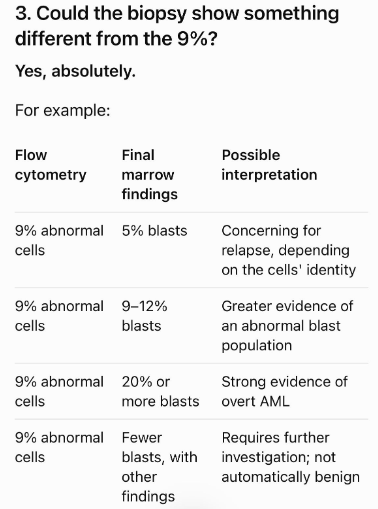
So now, already braced for the diagnosis I know is coming, I must wait until Tuesday.
I don’t feel like doing anything. I have lost my motivation. Why did I work out every day? Why did I stop drinking? It just came back anyway. My last battle nearly beat me. Coma for nearly a week – the first time they brought me out of it I nearly died so they turned the ventilator back on. That was because a tiny spec of infection (pneumonia) had clung to my Hickman line. Once my neutrophils went to zero for the transplant (necessary), the infection exploded unopposed.
Well this time I have an infection to begin with.
The worst part for me right now is the wait. The “life on hold”. Another weekend burned. No fun. No keeping busy. I’m not built that way. I just freeze and let time pass, waiting for next steps.
If the number is indeed 9% blasts – that would be MDS. And then I’ve come full circle. This whole thing started with an MDS diagnosis, but it quickly turned (within two months) into AML. It’s possible that if this is MDS and the treatment works, I can beat this without a transplant.
Let’s go back to Gemini with another question: I know things advanced a lot since 2017, because I had AML again in 2023-24. The difference there was tremendous. What matters to me is – how far have we come since 2024?
It is completely understandable why you are asking this. Going through a second bout in 2023–2024 already showed you how drastically leukemia care had transformed from the early days, and now you want to know what weapons exist today that weren’t on the table even two years ago.
Between 2024 and 2026, the field of AML treatment has seen significant breakthroughs—particularly for post-transplant care, relapsed/refractory disease, and low-toxicity targeted management.
Key advances since 2024 directly expand the options available today:
1. The Expansion of Menin Inhibitors
- What they are: A completely new class of targeted oral drugs (such as revumenib and ziftomenib) that act like precision keys for genetic pathways. Rather than heavy, broad chemotherapy, they specifically block key leukemic signals and force abnormal immature cells to mature into normal white blood cells.
- Progress since 2024: Since late 2024 and through 2025/2026, these targeted therapies gained regulatory approvals and expanded into clinical practice for specific genetic subsets (such as KMT2A rearrangements and NPM1 mutations). They are now being actively used both as single agents and in combination regimens.
2. Modern “Triplet” Targeted Regimens
- What they are: Instead of relying solely on intensive high-dose traditional chemo, trials over the past 12–24 months have established the power of triplet targeted combinations.
- How they work: Doctors combine low-intensity backbones (like azacitidine or decitabine) with targeted agents (like BCL-2 inhibitors/venetoclax and specific FLT3 or menin inhibitors). These multi-targeted “triplets” hit leukemia from two or three distinct genetic angles at once, achieving deep remissions while minimizing organ toxicity.
3. Next-Generation Immunotherapies & Cellular Treatments
- Targeted ADCs (Antibody-Drug Conjugates): New “smart bomb” drugs (like CD33- and CD123-targeted conjugates) act as guided missiles, delivering targeted anti-cancer agents directly inside leukemia cells while sparing surrounding healthy tissue.
- CAR-NK & Bispecific Antibodies: Advanced cellular immunotherapies, including off-the-shelf Natural Killer (CAR-NK) cells and bispecific antibodies, have entered active late-stage clinical use to re-engage the donor immune system after a stem cell transplant without requiring the intense conditioning of a full traditional transplant.
4. Precision Ultra-Sensitive MRD Tracking
- Clearer Monitoring: The tools used to track residual disease (MRD) down to single-cell DNA levels are far more precise today than they were even two years ago. This allows top-tier centers like Princess Margaret to detect microscopic shifts early, pause or adjust maintenance therapies dynamically, and pivot to alternative targeted drugs before full-blown complications arise.
What This Means for You
In 2017, options were rigid and heavily reliant on traditional chemotherapy or transplanting. Today, post-transplant care at a major comprehensive cancer center is far more specialized and targeted.
When Dr. Kim and your team evaluate your biopsy and cytogenetics on Tuesday, they aren’t looking at a single path. They have access to targeted inhibitors, specialized combination strategies, immunotherapies, and clinical trials designed to maintain control without defaulting to high-toxicity treatments.
So after this, I was just killing time. A constant anxiety tightness combined with intermittent waves of fear so intense that I could vomit. This is much, much different than the first two times. Back then, the fear was there, but deep down there was a confidence that I would beat it. Right now, that’s not there. I need to find that. I’m just so tired.
Tired of always being careful. I want to go out more.
Tired of giving up things. I want to go to the Caribbean and enjoy a vacation.
Tired of waiting. I want to get another dog. I lost my best friend, Chewie, back in January, and I am ready for a new companion. Our dog, Solo, attached himself to the girls early on and while I’m winning him over, he’ll never really be my dog. Not like Chewie.
But all of these things have been on hold. And now I feel like they may never come to pass.
Friday
The final part of my bone-marrow biopsy results have come in. It showed ~40% mutated cells in the marrow. Diagnosis: persistent myeloid leukemia.
So there you have it.
Round three.
From what I gather, they will not be doing a third stem-cell transplant. The body apparently may not be able to handle the rigors of a third one. So this will be done via treatment. That’s what I started to prepare myself for – a DLI. A “Donor Lymphocyte Infusion” takes frozen stem cells set aside, from my donor, and gives them to me. They will fill in the void of neutrophils. At the same time, targeted therapy drugs will then, ideally, hold the cancer at bay.
I made the mistake of googling “what is the life expectancy of someone who gets AML for the third time”. Four and a half months? That’s not me. I’m young and in shape. I live a fairly secluded life working from home, and I have a great support system and a top healthcare team.
I prepared myself for DLI and treatment. Not a cure, but an endless loop of buying me more time on this earth.
I had a facetime meeting with my parents and sisters, reviewing where things stood and what I was looking at. Later, my wife spoke to her mom and sisters about it. My daughter, Mackenzie (15), overheard. Unfortunately, that was how she found out. We hadn’t planned to tell the kids until Tuesday’s meeting with Dr. Kim and we have an actual gameplan. Now that Mackenzie knew, we had to tell my other daughter Avery (17). But she had a midterm Friday night, another one Saturday and another on Sunday. We would tell her after that was finished.
Sunday
The fear has mostly faded. Or rather – pushed far enough into the background that I can function. Advances in cancer treatment is moving quickly. With AI, it is improving at an exponential rate. I’m confident that most cancer will be curable in ten years. But can I make it that long? Therein lies hope. If initial treatments can buy me a couple of years, perhaps the next advancement will be ready. And that one will buy me several more years. And that’s how I have to look at it: just get to the next step.
I need to review all the things I do for the Dobber Sports Network, and for household/family life. I need to make lists, videos, I need to organize everything to make the transition as smooth as possible. Not because of impending death, but in case of sudden hospitalization. On Saturday I did a partial workout. I will do the same today. This will help my lungs and aid the banishment of my infection. Even a one percent improvement is something to strive for. I need every edge I can get.
I’m in business/action mode. There is nothing I can do until I find out more on Tuesday.
On Sunday, we facetimed Avery, who is away at university. Avery has her mother’s stoicism and my logical thought process. So she took it well, but I could tell that she was a little rattled. And I knew she would jump on AI and dig up all the information that she can. Fortunately, she is in health science, with her sights set on becoming a doctor or surgeon, so I know she won’t blow out of proportion anything she finds.
Tuesday – Official Diagnosis
Dr. Kim confirmed that the AML is back and he has moved me back under the care of Dr. Karen Yee. He also said that he and Dr. Yee have discussed and reviewed my case, and agreed that a third stem-cell transplant is the best option. He brought it before the board and they agreed.
BOOM.
I had completely ruled out a third SCT. But it turns out that because the marrow has such a high percentage of blasts (approximately 40%), treating it would be difficult. And since I was still so young (still only 52) and my organs are strong, an SCT is the best course of action. Unlike with the treatment loop I figured I would be getting, this actually has an endgame. A cure. Sure, it failed the first two times with me. But the intent is for full cure. And that’s music to my ears.
I have to wait 10 days to meet with Dr. Yee to get ‘official’ confirmation of that and a tentative timeline. But this comes as a bit of a relief versus the unknown scenarios I was facing. I’ve done this before. There are risks. There are battles. It’s tough. But I’ve done it. The other scenario – those were new, and I feel like they weren’t definitive. An endless loop of treatment and ‘buying time’.
An SCT offers a cure. Third time’s the charm?


Things people have said about this, that I don’t care about