It’s been an interesting last six weeks since the last update, and I’ll summarize it here. Perhaps you, or someone you know, is going through a second bout with leukemia and having a second stem-cell transplant (SCT). Perhaps this helps prepare you for what’s to come.
Things at home have returned to normal as we play the waiting game. Visits from friends and family are kept to a minimum and I have gone the entire five-plus weeks without getting sick. I had my second SCT scheduled for February 13, and I would be admitted February 7.
I began working out again, taking it easy at first but slowly building my way back up.
Prior to the diagnosis, I was doing 3.6 miles daily on the treadmill, with 8-pound dumbells in my hands, plus 100 pushups and 50 situps. I have since topped 3.0 miles, but it has been too much. Now I average about 2.7 miles, 90 pushups and 40 situps about five days per week. Not what it was, but better than nothing. I remember after my last transplant that I had no strength and very little muscle. I want things to be different this time.
About the Transplant
Just like in 2017, I was again given a 40% two-year survival rate after the transplant. I was told it would be 0% without it. I beat it last time, will beat it again. I’m in better shape physically this time around. Not worried.
I was also told they will be using a different donor this time. “A new army to fight” is the reasoning they used. Apparently, they found four donors who are a 100% match.
The process needed to put all this together is quite complex. The donor needs to go in for four days, each day getting a quick injection that will get the stem cells into the blood stream. Then it will be a three-hour visit to harvest them – drawing blood from one arm and returned to the other arm after the stem cells are harvested.
After this, the stem cells have 24-48 hours to get to me. In this case, they are coming from overseas.
Meanwhile, this all has to be timed with my own preparation, which includes getting a bed. But also for each of the four days prior, I will be getting two different powerful chemo drugs that will wipe out the bone marrow that I have. Last time, in 2017, this ended with radiation. With new chemo this time, I won’t need that. With no marrow, means zero immunity. So for those few days I will be deathly vulnerable to the slightest thing, even the common cold.
So this will time perfectly with the plane landing and emergency vehicles rushing the stem cells to me. I can’t imagine the coordination involved.
Transplant Re-scheduled
For one reason or another, the donor could not meet the dates originally scheduled. So I have a new transplant date: March 5, admission date: February 28
The worst thing about the postponement is that everything gets postponed. My recovery. Being able to go into crowds. To go to gatherings of family and friends. And this is a bad year for a delay of even one month: I turn 50 on April 2. That means there is a chance I’ll still be in the hospital for that milestone. But it also means that many of my peers are also turning 50. So many other big 50th events/gatherings I’ll have to miss. I’ll definitely still be in the hospital for St. Patrick’s Day, which is probably my favorite event of the year as I get older. And events for the kids, such as soccer tourneys, etc. Postponement means another month of missing those things.
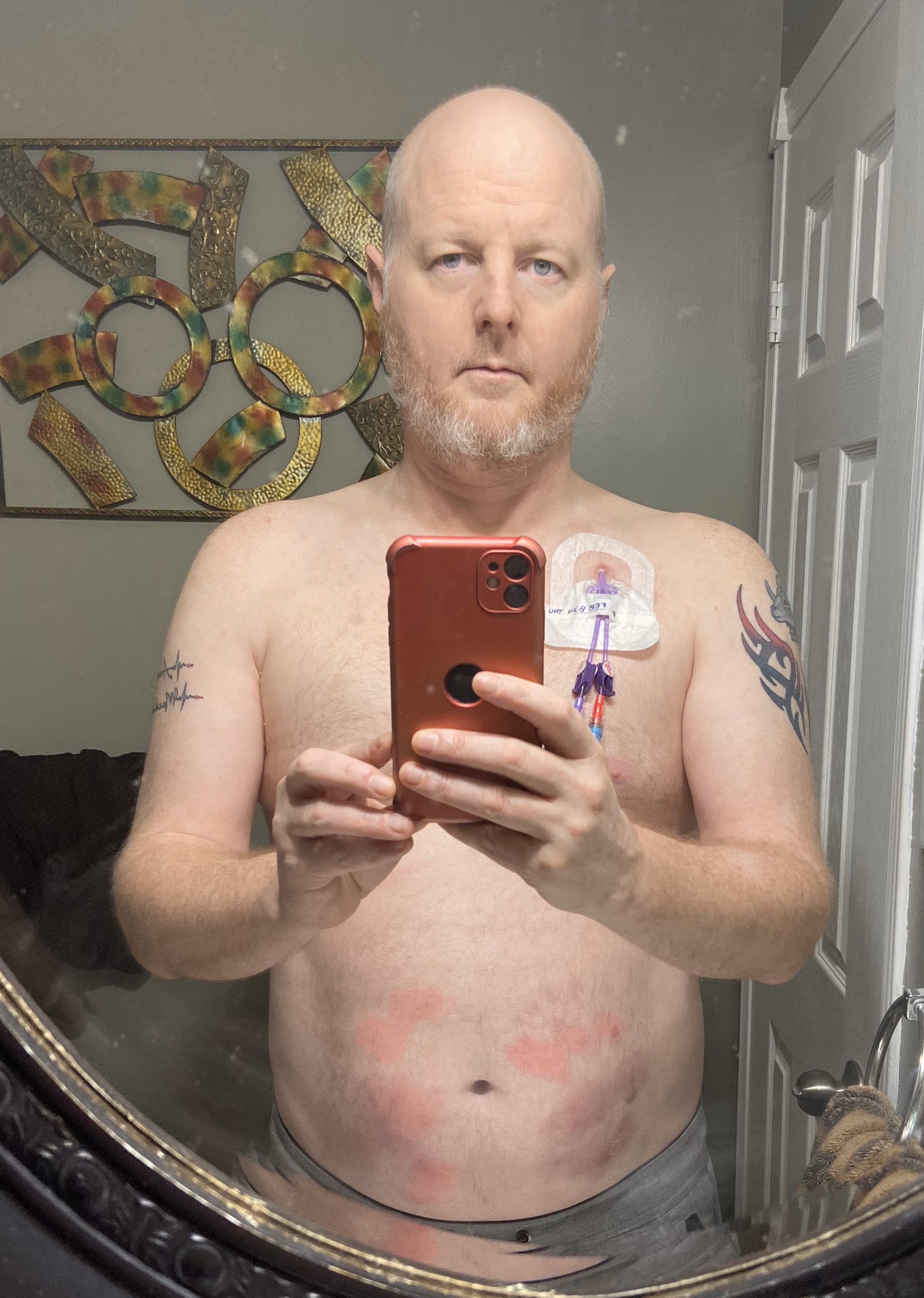
Another bad thing – now I have to go through a third cycle of chemo. I don’t mind the pills, those are fine. But the cycle kicks off with six consecutive days of getting three needles in different spots of my stomach. They don’t hurt, but they turn pink/red/purple around those spots and shirts irritate it when it rubs. And this week the average commute to the hospital has been about 90 minutes each way, plus the cost of parking. So a secondary thing I thought of when told of the delay and of having to undergo a third cycle was: shit, I have waste six days of driving back and forth. Six days of early mornings.
But, if it gives me an edge to beat this thing, I gotta do it.
Update: It actually does hurt. This third cycle left my stomach with what looks and feels like bad sunburns. Here is a picture:
Questions I Asked
What happens if the stem cells do not graft?
They would go back to the donor and harvest more stem cells ASAP and try it again. I would remain in hospital until they give it another go. But for a 10/10 match this is a rare occurrence. It would still be considered my second stem-cell transplant (i.e. it would be considered the same procedure).
What is the main cause of death within two years?
With a 40% survival rate after two years, this is a good question. Pretty much the only cause of death is through infection. Getting the flu, or a virus. Since I’m still relatively young (not quite 50), and fit, and my business is a home business with very little interaction with the public, I am in a good spot.
What are the historical odds of dying while in hospital during that first month after transplant?
Next to zero. Very low percentage.
So the peak window where the risk is the highest is between the moment I leave the hospital…until six months post-transplant?
Correct. The real risk window is in the first two years, but the first six months are the highest. And since you are in the hospital under constant care with little outside interaction, that first month is low risk even though you are at your most vulnerable.
Has anyone ever had a third stem-cell transplant?
It has happened, but not at Princess Margaret Hospital. It’s very rare, which is understandable because most of the people in this position are over sixty years old when they have the first one. By the time we’re talking about a third one, they could be well into their seventies. Because you had your first one at forty-three and your second one now at forty-nine, it would certainly be within the realm of possibility. But we are going into this with the goal of a complete cure.
Donor Registration: Non-whites Need to Step Up
In speaking with the doctor, we were told that as a Caucasian with European descent, there as a 99% chance these days that I would find a 10/10 stem-cell donor match. The doctor, who is Hispanic, said that his odds were more like 50%. My wife, who is West Indian, would have 20% odds. Twenty percent! If you’re reading this and you fall into either of the latter two categories and are between the ages of 17 and 36, please register!


 Dobber's Take
Leave a comment